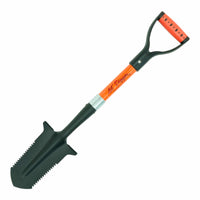
The Case for a Closed Grip
An open shaft relies on grip strength to keep the tool from twisting or sliding, and grip strength is exactly what fades first on a cold, wet hunt. The D closes the system: your hand sits inside a loop that is anchored on both sides, so the tool cannot rotate out of a gloved or muddy hand, and the pull comes from your whole arm rather than your fingers. Short, controlled strokes are the D-handle's natural rhythm, which is why the style shows up on shovels meant for precise plug work as much as on heavy diggers.
Where a D-Handle Earns Its Keep
Clay ground is the headline use. When a plug seats itself in wet clay, you lever it out by pulling back on the handle, and a closed loop lets you throw your weight into that pull without the shaft slipping through your palm. Cold-season hunts are the second: winter gloves that would slide on a bare shaft lock into a D grip. And because the loop keeps the tool controllable with one hand, a D-handle suits the lift-and-toss motion of moving spoil out of a deep hole while your other hand steadies the edge.
Choosing Between D, T, and Straight
A T-handle beats the D when you need two hands and boot drive for deep plugs and root-laced ground. A standard straight handle stays the lighter, simpler all-rounder that packs easiest. If you dig clay, hunt gloved, or want one-handed control, the D is the right call. The full range is in all shovels, diggers and picks, and a pinpointer shortens every recovery no matter which handle you swing.