


The Le Trap Gold Pan revolutionizes gold recovery with deep riffles that trap fine gold while letting lighter material wash away. This guide walks you through proper panning techniques, from initial setup to final gold recovery.
Understanding Gold Pan Physics
A gold pan separates gold from sand and gravel using specific gravity. Gold weighs 19 times more than water, while most sand and gravel are only 2-3 times denser. This massive density difference makes gold sink fast when material is agitated in water.
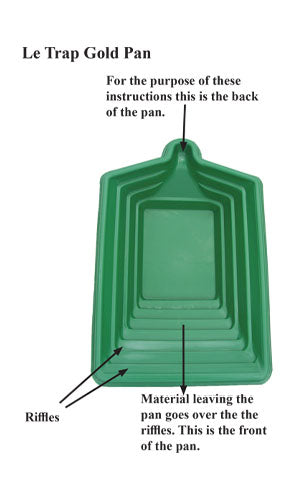
The Le Trap design features deep riffles - ridges that catch gold as lighter material flows over them. These riffles act as natural gold traps, preventing valuable material from accidentally washing out during the panning process.
Essential Gold Recovery Tools
Different sized gold requires different recovery methods:
- Pickers: Large pieces you can grab with fingers
- Tweezers: For medium flakes too small to pick up
- Suction tweezers: Work like eyedroppers for fine gold
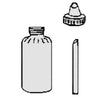
- Snuffer bottles: Essential for collecting tiny flakes

Current Gold Prices and Value
Gold has served as currency throughout history. From 1786 to 1934, gold was fixed at $20 per ounce. By 1975, prices floated freely, reaching $850 in 1980 before dropping to $272 by 2000.
Gold Price History Since 2000:
| 2000 $279 | 2012 $1667 |
| 2001 $271 | 2013 $1413 |
| 2002 $309 | 2014 $1199 |
| 2003 $363 | 2015 $1142 |
| 2004 $409 | 2016 $1252 |
| 2005 $444 | 2017 $1260 |
| 2006 $603 | 2018 $1268 |
| 2007 $685 | 2019 $1393 |
| 2008 $875 | 2020 $1773 |
| 2009 $969 | 2021 $1798 |
| 2010 $1286 | 2022 $1801 |
| 2011 $1662 | 2023 $1940 |
At current prices around $1,900 per troy ounce (31.1 grams), each gram is worth about $60. That's the weight of a dollar bill. A nickel weighs 5 grams - worth $300 in gold.
Understanding Pennyweight and Grains
Prospectors often measure gold in pennyweight and grains. This system originated in 15th-century England when an English penny weighed exactly 1/20th of a troy ounce. There are 20 pennyweights per troy ounce, with each pennyweight containing 24 grains (480 grains per troy ounce total).
Preparing Your Le Trap Gold Pan
New plastic gold pans have a chemical film from injection molding that makes water bead up. This film interferes with proper panning technique. Wash your new pan with mild detergent to remove this coating before first use.
Step-by-Step Le Trap Panning Technique
Practice in a tub first so you can recover material and repeat the process while learning.
Step 1: Load and Saturate Material
Fill the pan with gravel and add enough water to cover everything completely.

Step 2: Settle the Gold
Hold the pan level and shake vigorously to settle heavy material to the bottom. Mix gravel with your fingers to break up clay and expose gold.


Step 3: Wash Away Light Material
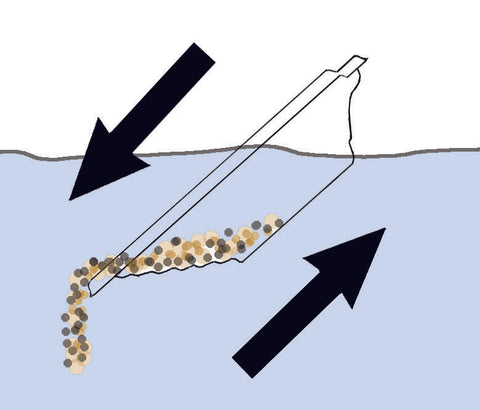
Dip the pan in water and tilt it so lighter material washes out. Keep the riffles facing away from you - material must travel across these ridges to exit the pan.

Step 4: Repeat the Cycle
Level the pan and shake again. Repeat steps 2 and 3 until you have a small amount of concentrated material in the bottom.

Back Panning for Final Gold Recovery
When you're down to a small amount of concentrate, use back panning to separate the final gold.

Add a small amount of water and tip the pan forward so all material settles near the first riffle. Tap the front edge to help material migrate.

Level the pan, then tip it back so water flows away from the riffle. Rock the pan forward and back gently. The gold will separate and become visible at the front edge after several cycles.


Use suction tweezers like an eyedropper to pick up the gold and transfer it to a small vial.
Dealing with Black Sand
Black sand consists of iron minerals from the same geological formations that contained gold veins. While it makes panning more difficult due to its fine, dense nature, black sand indicates highly mineralized material that's more likely to contain gold.
Magnetic Black Sand Removal
Some black sand is magnetic and can be removed with magnets. Always keep material covered with water when using magnets, and hold the magnet above the water surface to avoid accidentally picking up gold in wet clumps.
Special black sand magnets are designed to lift magnetic material and easily release it when moved away from the pan.
Gold Panning vs Metal Detecting
While gold pans recover gold from stream sediments, many prospectors wonder if metal detectors can find gold nuggets in the ground. Modern gold detectors use high-frequency technology specifically designed to detect small gold nuggets that other detectors might miss.
The best approach combines both methods - use a metal detector to find nuggets in dry ground, then pan nearby streams and washes where water has concentrated fine gold over time.
Essential Gold Panning Supplies
A complete gold panning kit includes more than just the pan. You'll need:
- Le Trap gold pan with deep riffles
- Classifier to screen material by size
- Snuffer bottle for fine gold recovery
- Tweezers for medium-sized flakes
- Small shovel or scoop for loading material
- Black sand magnet for removing magnetic minerals
- Small vials for storing recovered gold
Where to Find Gold for Panning
Gold concentrates in areas where water slows down and drops heavy material. Look for inside bends of streams, areas below rapids or waterfalls, and natural cracks or crevices in bedrock. Always check local regulations and obtain permission before panning on private property.
Research historical gold-producing areas in your region. Many states have designated recreational panning areas where the public can search for gold legally.
