


The E-TRAC's SmartFind display gives you precise target information through its two-axis system. The horizontal CO axis measures conductivity from 1-50, while the vertical FE axis shows ferrous content from 1-35. Understanding these readings transforms how you hunt with this advanced Minelab metal detector.
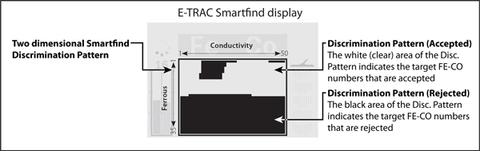
How the FE-CO Coordinate System Works
The horizontal axis rates the target on its size/conductivity (CO), ranging 1–50 from left to right. The vertical axis rates the extent of the target's ferrous characteristics (FE), ranging 1–35 from top to bottom. A FE value of 1 represents low ferrous characteristics and a value of 35 represents high ferrous characteristics. Similarly, a CO value of 1 represents low conductivity and 50 represents high conductivity.
This dual-axis approach lets you see exactly what's beneath your coil before you dig. High-conductivity targets like silver coins typically show up in the CO 45-50 range with low FE numbers (1-5). Iron trash clusters in the high FE zone (25-35) regardless of conductivity.
Reading Target Patterns on SmartFind
Good targets create tight, consistent patterns on the display. A silver quarter might consistently hit FE 02, CO 47 from multiple sweep angles. Junk targets scatter across wider areas or jump between coordinates.
Here's what different target types typically show:
- Silver coins: FE 01-05, CO 43-50
- Copper pennies: FE 15-25, CO 35-43
- Aluminum foil: FE 01-10, CO 10-25 (scattered pattern)
- Iron nails: FE 30-35, various CO readings
- Gold jewelry: FE 12-18, CO 8-25 (size dependent)
Multi-Angle Target Verification
Always check targets from 90-degree angles. Real coins maintain consistent FE-CO coordinates, while bottle caps and other junk often shift dramatically. This technique separates the E-TRAC from simpler metal detectors that rely on single-tone ID.
SmartFind vs Other Minelab Technologies
The E-TRAC's FBS (Full Band Spectrum) technology feeds SmartFind with 28 simultaneous frequencies. This differs from newer Minelab Equinox models that use Multi-IQ but display targets on a simpler numerical scale.
Compared to the Minelab CTX 3030, the E-TRAC offers similar target separation but with a less complex menu system. Both use the FE-CO coordinate system, making them excellent choices for relic hunting in iron-contaminated sites.
Advanced SmartFind Discrimination Patterns
The E-TRAC lets you create custom discrimination patterns by accepting or rejecting specific FE-CO coordinates. Start with the Coin pattern and adjust based on your hunting conditions.
For beach hunting, accept higher FE numbers to catch gold rings masked by mineralization. In old home sites, reject the FE 30-35 range entirely to eliminate most iron false signals while keeping good targets.
Site-Specific Pattern Adjustments
Trashy parks require tight discrimination around known good target zones. Clean farm fields let you open up the pattern to catch deeper, weaker signals that might scatter slightly on the display.
Save different patterns for different hunting scenarios. The E-TRAC's memory holds multiple custom settings, letting you switch quickly between park hunting and relic detecting modes.
Depth and SmartFind Accuracy
Target ID accuracy decreases with depth, but SmartFind remains useful deeper than basic detectors. At 8+ inches, expect some FE-CO scatter even from good targets.
Deep silver often reads slightly higher on the FE scale due to ground mineralization effects. A deep seated liberty that normally hits FE 02, CO 46 might read FE 08, CO 44 at 10 inches deep.
Common SmartFind Mistakes to Avoid
Don't trust single sweeps over targets. The E-TRAC needs multiple passes to analyze complex signals properly. Quick sweeps often produce inaccurate FE-CO readings.
Avoid discriminating out the entire middle ground between obvious trash and obvious treasure. Many good targets—especially gold jewelry—fall into these "maybe" zones on the display.
Ground Balance Impact on Display
Poor ground balance affects SmartFind accuracy more than simple beep-and-dig machines. Always ground balance when moving between different soil types or mineralization levels.
Highly mineralized ground shifts all targets slightly higher on the FE scale. Compensate by opening your discrimination patterns in tough ground conditions.
Comparing E-TRAC to Current Minelab Models
While newer models like the Minelab EQUINOX 900 offer faster recovery speeds, the E-TRAC's SmartFind display provides more detailed target analysis. The visual feedback helps experienced users make better dig decisions in complex target environments.
For beginners moving up from basic detectors, the learning curve is steeper than plug-and-play models. But the E-TRAC rewards users who master its display system with significantly better target identification in challenging conditions.
